

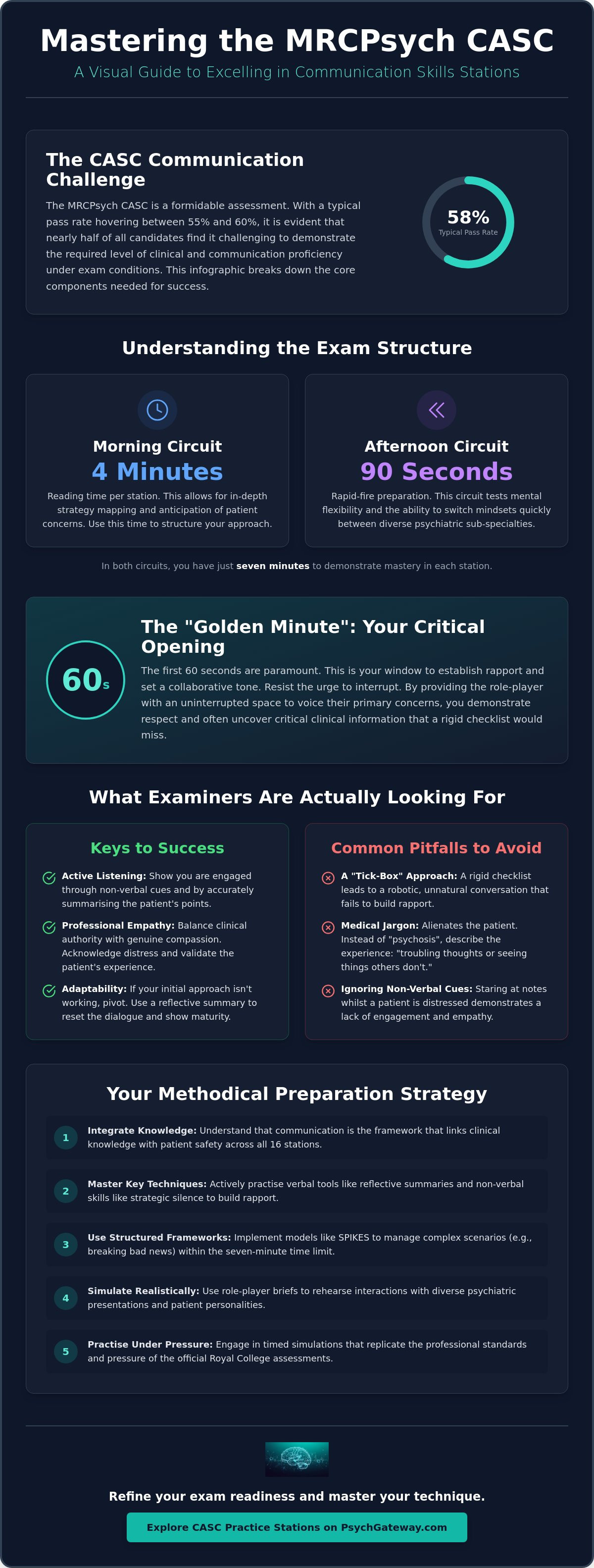
Did you know that the MRCPsych CASC pass rate typically sits between 55% and 60%? This statistic highlights that nearly half of all candidates struggle to translate their clinical expertise into the specific performance required on exam day. It's entirely natural to feel anxious about the perceived subjectivity of the CASC communication skills stations, particularly when you must balance empathetic dialogue with strict clinical safety in just seven minutes. Transitioning from the rigid structure of Paper A and B to the fluid demands of a role-play scenario often feels like the most significant hurdle in your postgraduate journey.
This guide provides the structured frameworks and refined techniques you need to master these high-pressure encounters with professional composure. We will break down the official marking criteria used by examiners to ensure your performance aligns with the required standards. You'll gain a practical toolkit of verbal phrases and non-verbal cues designed to build rapport quickly. By the end of this article, you will have the confidence to handle difficult role-player scenarios and the clarity to excel during the September 2026 sittings.
Key Takeaways
- Understand why communication is the foundational element that integrates clinical knowledge with patient safety across all 16 stations of the exam.
- Master the specific verbal and non-verbal techniques, such as reflective summaries and strategic silence, required to pass CASC communication skills stations.
- Implement structured frameworks like SPIKES to manage complex scenarios, including breaking bad news and ethical dilemmas, within the strict seven-minute timeframe.
- Develop a methodical preparation strategy using role-player briefs to simulate realistic patient interactions and diverse psychiatric presentations.
- Refine your exam readiness by engaging with timed simulations that replicate the pressure and professional standards of the Royal College assessments.
Understanding the Role of Communication in the MRCPsych CASC
The CASC is a high-stakes assessment designed as a specialised Objective Structured Clinical Examination (OSCE). Within this two-circuit structure, communication isn't merely an isolated skill; it's the essential framework that supports every history-taking and management task you perform. If you view CASC communication skills stations as separate from clinical logic, you'll likely struggle to meet the passing threshold. In 2026, the Royal College has placed an even greater emphasis on shared decision-making and patient-centredness. This means you aren't just presenting a treatment plan; you're actively negotiating it with the person in front of you. Communication is the glue that holds your clinical knowledge together, ensuring that your expertise is delivered in a way that is safe, empathetic, and effective.
You have seven minutes to demonstrate this mastery. The first 60 seconds are the most critical. During this brief window, you establish the rapport that dictates the rest of the encounter. If you appear rushed or overly clinical, the role-player may become defensive, making it significantly harder to extract sensitive information or gain consent. Aim for a composed, professional opening that acknowledges the patient's current state immediately. This sets the tone for a collaborative dialogue rather than a one-sided interrogation.
The Difference Between Morning and Afternoon Circuits
Morning stations offer four minutes of reading time, giving you space to map out your communication strategy and anticipate potential patient concerns. By contrast, the afternoon circuit demands rapid-fire 90-second preparation. This requires incredible mental flexibility and the ability to switch mindsets quickly between different psychiatric sub-specialties. The examiners use a "Global Rating" score to assess your overall professional behaviour. They aren't just looking for correct facts; they're looking for a doctor who remains composed and empathetic under pressure.
Marking Criteria: What the Examiners Are Actually Looking For
Examiners look for a sophisticated balance between verbal fluency and non-verbal cues. If you're staring at your notes whilst the patient is expressing distress, you'll fail to demonstrate active listening. It's vital to avoid a "tick-box" approach. A rigid checklist often leads to a disjointed conversation that feels unnatural and robotic. If you realise your style is failing to land, don't panic. Pivot your approach immediately. Use a reflective summary to acknowledge any friction, then reset the dialogue. This ability to recover shows the professionalism and maturity required to succeed in CASC communication skills stations.
The Core Components of Effective Clinical Communication
Mastery of CASC communication skills stations begins with understanding the "Golden Minute." This is the initial period where you provide the role-player with an uninterrupted space to voice their primary concerns. By resisting the urge to interrupt with closed questions, you demonstrate immediate respect for the patient's narrative. This approach doesn't just build rapport; it often reveals critical clinical information that a rigid history-taking template might miss. Effective clinical communication is a blend of active listening and strategic verbal interventions. Use "verbal nods" and paraphrasing to confirm you've understood the patient's perspective. This validates their experience and fosters a collaborative atmosphere from the outset.
Language and Tone: Professionalism whilst Building Rapport
Clarity is paramount. You must avoid medical jargon that can alienate or confuse a patient. For instance, instead of using the term "psychosis," describe the experience as "troubling thoughts or seeing things that others don't." When discussing "sectioning," explain the legal framework of the Mental Health Act in simple, reassuring terms. International candidates often find that British clinical communication requires a shift from formal politeness to a more nuanced "professional empathy." Speak at a measured pace. A slower, deliberate tempo suggests composure and gives the role-player time to process information. If you're looking to refine these nuances, reviewing CASC practice stations can help you adapt your style to the specific requirements of the UK context.
Non-Verbal Mastery: Beyond the Words
Your body language often speaks louder than your words. The SOLER framework is a helpful guide: sit squarely, maintain an open posture, lean in slightly, keep comfortable eye contact, and remain relaxed. These cues signal that you're fully present. Academic institutions, such as those providing the UCL MRCPsych CASC course, frequently emphasise that non-verbal cues are just as weighted as clinical accuracy. Manage the transition between note-taking and engagement carefully. If you must write, explain this to the patient first to avoid breaking the connection. Most importantly, recognise role-player cues. If a patient becomes tearful or silent, stop your questioning. Acknowledge the emotion and allow the silence to exist. This demonstrates a high level of emotional intelligence that examiners highly value.
Navigating High-Stakes Communication Scenarios in the CASC
Success in CASC communication skills stations requires more than just kindness; it demands a disciplined application of communication frameworks under extreme time pressure. When breaking bad news, you must adapt the SPIKES framework to fit the seven-minute limit. Prioritise the "Warning Shot" and the "Empathy" stages. You don't have time for a lengthy preamble. Deliver the information clearly, then pause. This silence allows the role-player to process the news, giving you the necessary space to assess their reaction and respond with genuine support. Managing an angry or hostile patient requires similar precision. Stay composed. Avoid becoming defensive. Use de-escalation techniques that acknowledge the patient's frustration whilst maintaining professional boundaries. This preserves the doctor-patient relationship and ensures the station remains focused on the clinical task.
Ethical dilemmas regarding capacity, consent, and confidentiality often catch candidates off guard. The key is to explain the legal and professional requirements without sounding like you're reading from a textbook. If a patient refuses a life-saving treatment, your role is to assess their capacity and explore their reasoning. Frame your questions around their understanding of the risks and benefits. When explaining management plans, move beyond a simple list of medications. Position the patient as an active participant. Ask, "How does this plan sound to you?" or "What are your main concerns about this approach?" This demonstrates the shared decision-making that is central to the 2026 marking criteria.
The Empathy Station: Validating Intense Emotions
It's vital to distinguish between sympathy and empathy during your assessment. Sympathy is feeling sorry for a patient; empathy is demonstrating that you understand their internal world. You can validate a patient’s distress by saying, "I can see how overwhelming this situation feels for you," without necessarily agreeing with their specific demands or delusions. Empathy in the CASC is the clinical ability to accurately perceive a patient's emotional state and communicate that understanding back to them to facilitate therapeutic progress. This skill is measurable and highly valued by examiners.
Handling Difficult Conversations with Relatives
Family-based stations require you to use a "Triadic" communication model. You must balance the needs of the patient, the relative, and your own clinical responsibilities. A common pitfall is breaching confidentiality to appease a distressed family member. Always clarify what information you can share before the relative enters the room. If they press for details you cannot disclose, acknowledge their anxiety whilst firmly stating your professional obligations. This approach demonstrates integrity and protects the patient's rights, which is a core component of CASC communication skills stations.
Strategic Preparation: How to Organise Your CASC Communication Practice
Success in CASC communication skills stations is not a result of natural charisma; it's the product of deliberate, repetitive simulation. You must move beyond passive reading and engage in active rehearsal that mimics the cognitive demands of the Sheffield circuits. To build a robust preparation programme, follow this sequential five-step framework:
- Step 1: Form a study group. Aim for a group with diverse backgrounds. Exposure to different communication styles will help you adapt to the various role-player personalities you'll encounter on exam day.
- Step 2: Use detailed Role Player Briefs. A high-quality brief includes hidden agendas and specific emotional triggers. This forces you to probe deeper and manage resistance, rather than just reciting a script.
- Step 3: Record your sessions. With your colleagues' consent, film your practice. Critiquing your own non-verbal behaviour is the most effective way to identify distracting habits like excessive fidgeting or a lack of eye contact.
- Step 4: Master the 5-minute warning. Practice the transition from the exploration phase to the management phase. You must learn to wrap up your history-taking and pivot to a collaborative plan without sounding abrupt or dismissive.
- Step 5: Seek dual feedback. Ensure one person marks you against the official Royal College criteria whilst the role-player provides feedback on the "human" element of the encounter.
The Role of Feedback in Refining Technique
Patient feedback is often the most valuable tool for mastering communication. Whilst an examiner focuses on clinical safety, the "patient" can tell you if they felt truly heard or if your empathy felt rehearsed. Don't try to fix everything at once. Focus on one specific behaviour per practice session. You might spend one evening solely on your opening minute and another on your ability to deliver reflective summaries. This granular approach ensures deep comprehension and long-term mastery. To begin this structured rehearsal, you can utilise our professionally designed CASC Practice Stations to ensure your simulations remain realistic and challenging.
Special Considerations for International Medical Graduates (IMGs)
International Medical Graduates often face the additional challenge of interpreting the subtle nuances of British social cues. "British Empathy" is frequently delivered through specific linguistic markers and a carefully balanced tone that avoids being overly emotive whilst remaining warm. If you encounter a language barrier, don't ignore it. Use clarifying techniques such as, "I want to make sure I've understood your perspective correctly; could you tell me more about that?" This demonstrates clinical care and professional integrity. For a broader perspective on the exam journey, including theory papers, refer to our IMG MRCPsych preparation guide.
Refining Your Technique with Psychgateway CASC Practice Stations
Psychgateway provides a specialised simulation environment engineered to replicate the specific cognitive load of the Royal College assessments. Transitioning from the theoretical rigour of Paper A and B to the practical demands of CASC communication skills stations requires a fundamental shift in how you process information. Our platform facilitates this by offering over 110 stations that cover the full breadth of the psychiatric syllabus. You can access scenarios ranging from CAMHS and Learning Disabilities to complex Forensic psychiatry and Older Adult presentations. Each station includes comprehensive explanations that deconstruct the "why" behind successful communication. Instead of encouraging rote memorisation, we focus on the logic required to adapt your style to unpredictable role-player reactions.
The 2026 marking criteria place a heavy emphasis on your ability to remain composed whilst delivering safe, patient-centred care. Our practice stations help you internalise these professional standards through repetitive, high-fidelity simulation. By the time you reach the Sheffield circuits in September, the seven-minute structure will feel like second nature. You'll have the mental bandwidth to focus on the role-player's cues rather than worrying about the timer. This level of readiness is what separates a borderline performance from a clear pass.
Integrated Learning: From MCQ to Mock Station
Many candidates find it difficult to apply ethical principles to real-time clinical dialogue. Our platform bridges this gap by integrating theoretical ethics with practical simulation. You can use our Timed Mock Exams to build the mental and physical stamina required to navigate a full 16-station circuit without losing focus. If you're still in the early stages of your preparation, it's wise to ensure your foundational knowledge is secure. You can enhance your foundation with our MRCPsych Paper A question bank before moving on to full-scale clinical simulations. This integrated approach ensures that your management plans are both clinically accurate and empathetically delivered.
Start Your CASC Journey with Confidence
We invite you to experience our simulation tools first-hand by taking advantage of our three-day free trial for our CASC Practice Stations. This trial gives you full access to our frameworks and feedback loops, allowing you to test our methodology before committing to a subscription. By choosing Psychgateway, you join a community of successful candidates who have mastered the CASC through disciplined, structured practice. Communication is not an innate talent; it's a clinical skill that you can, and will, improve with the right guidance. Your path to becoming a Member of the Royal College is a journey we are proud to support. Take the first step toward mastery today and approach your exam with the confidence of a specialist.
Secure Your CASC Success in 2026
Achieving a pass in the MRCPsych CASC requires more than clinical knowledge; it demands a sophisticated integration of professional empathy and patient safety. You've explored how structured frameworks provide the stability needed to navigate complex CASC communication skills stations under intense time pressure. By moving from a tick-box approach toward genuine shared decision-making, you align your performance with the highest standards expected by the Royal College examiners. Meticulous, simulated practice is the only reliable route to this level of mastery.
Our platform, authored by Dr Sidra Bukhari, MRCPsych, ensures your preparation remains strictly aligned with the latest RCPsych CASC syllabus. You can begin refining your technique today by engaging with our comprehensive library of diverse clinical simulations. We invite you to Master the CASC with Psychgateway Practice Stations and take advantage of our 3-day free trial to experience our high-fidelity mock exams first-hand. You possess the expertise to succeed; now is the time to refine the communication skills that will define your career as a specialist. We're dedicated to supporting you every step of the way toward your MRCPsych qualification.
Frequently Asked Questions
How much do communication skills actually count towards my final CASC score?
Communication is a fundamental component of the domain-based marking scheme. It contributes significantly to the Global Rating and specific competency scores in all 16 stations. Even if your clinical facts are accurate, a failure to demonstrate professional rapport or empathy can result in a failing mark for the station. Examiners view these skills as inseparable from clinical safety.
What should I do if I completely freeze during a communication station?
If you freeze, use a reflective summary to regain your composure. Briefly summarise what the role-player has told you so far. This technique demonstrates active listening whilst providing you with a necessary mental pause to plan your next clinical move. It's a professional way to reset the dialogue without breaking the doctor-patient relationship.
Is it okay to use medical jargon if the role-player seems intelligent?
You must avoid medical jargon even if the role-player appears to have a high level of health literacy. The CASC assesses your ability to translate complex psychiatric terminology into clear, lay language. Using terms like "anhedonia" or "hypomania" without simple explanations may lead to a lower score in the communication domain, as it fails the test of accessibility.
How do I handle a role-player who is being intentionally difficult or silent?
Respond with empathy and de-escalation techniques. If a role-player is silent, acknowledge the difficulty of the situation and offer them space. For hostile role-players, remain professional and validate their frustration without becoming defensive. This approach ensures the station remains focused on clinical care whilst demonstrating your ability to manage challenging interpersonal dynamics.
Can I pass the CASC if English is not my first language?
Proficiency in English is required, but an accent or minor grammatical errors won't cause you to fail. Examiners prioritise your ability to convey empathy, ensure clinical safety, and build rapport. Focus on clear, paced speech and active listening rather than complex linguistic structures. Many successful candidates are International Medical Graduates who excel by mastering these core empathetic techniques.
Should I take notes during the 7-minute communication task?
Keep note-taking to an absolute minimum. Excessive writing breaks the non-verbal connection and can make the role-player feel unheard. If you must record a specific detail, such as a medication dose or a family member's name, inform the patient first. This transparency maintains the rapport required for CASC communication skills stations.
What is the most common reason candidates fail communication-heavy stations?
Candidates often fail by prioritising a rigid checklist over the patient's emotional narrative. If you ignore a role-player's distress just to finish your history, you'll fail to demonstrate the patient-centredness required by the 2026 marking criteria. A "tick-box" approach often feels robotic and prevents the development of a genuine therapeutic alliance.
How do I manage the 5-minute warning without sounding abrupt?
Transition naturally by acknowledging the remaining time. Instead of stopping your questioning abruptly, say, "I've gathered a lot of helpful information; in our remaining time, I'd like to discuss some options for your care." This keeps the patient an active participant in the management plan and ensures a smooth pivot from exploration to collaborative solution.