

If you believe that simply completing thousands of questions is enough to secure your membership, you may be overlooking the most critical factor in your preparation. A mock exam is only as valuable as its ability to simulate the psychological and technical pressure of the real MRCPsych environment. This MRCPsych mock exam comparison addresses the common fear of failing due to poor time management and the inconsistent quality found across various question banks. We understand that the sheer volume of the syllabus is overwhelming, making efficient revision an absolute necessity for 2026 candidates, especially as exam fees rise in line with the 3.6% CPI increase.
This guide provides a structured framework to evaluate the leading platforms available today. We'll help you identify resources that mirror the official exam interface, provide detailed explanations for every answer, and allow you to track your performance against your peer group. By the end of this article, you'll have the clarity needed to choose a specialist resource that fosters deep comprehension rather than superficial memorisation. Secure your readiness by selecting a tool that aligns with the latest standards and empowers you to approach your exam with professional composure and clinical mastery.
Key Takeaways
- Understand why full-length mock simulations are essential for building the three-hour mental stamina required for Paper A and Paper B success.
- Conduct a thorough MRCPsych mock exam comparison to ensure your chosen platform aligns with the current RCPsych curriculum and uses clinician-authored questions.
- Discover the logistical and educational advantages of digital formats, including automated marking and instant feedback, over traditional paper-based revision.
- Learn how to strategically time your baseline and mid-point mocks to validate your progress and refine your study focus throughout the year.
- Explore how integrating timed mocks and interactive CASC practice stations into your schedule provides the clinical mastery needed for a successful outcome.
The Role of Mock Exams in MRCPsych Success
Achieving the Membership of the Royal College of Psychiatrists (MRCPsych) represents a defining milestone in a trainee's career. It's a validation of clinical expertise and professional dedication. However, the transition from daily clinical work to the rigorous format of postgraduate examinations can be jarring. Success isn't merely a result of clinical knowledge; it's a product of your ability to perform under specific, high-pressure conditions. Whilst general revision builds your foundation, it's the strategic use of mock simulations that transforms this knowledge into exam readiness.
A comprehensive MRCPsych mock exam comparison shows that the most successful candidates are those who treat their revision as a series of performance rehearsals. Mock exams serve a dual purpose. They build the mental stamina required to remain focused during a gruelling three-hour Paper A or Paper B sitting. Simultaneously, they reduce exam-day anxiety by creating environmental familiarity. When you've already sat through multiple timed simulations, the actual exam interface feels like a known quantity rather than a source of stress.
Question Bank vs. Mock Exam: Knowing the Difference
Daily practice with a question bank is essential for learning granular facts, but it's often insufficient for final preparation. Many trainees fall into the trap of "cherry-picking" questions by topic, which allows for a comfortable, focused study session. This doesn't reflect the reality of the exam. A full-length mock forces you to handle mixed-topic fatigue, where you must switch rapidly between different psychiatric specialties whilst managing a ticking clock. The timed element fundamentally changes your decision-making behaviour, teaching you when to commit to an answer and when to move on to protect your overall score.
The Diagnostic Power of Mock Results
The true value of a mock exam lies in the data it provides after you've finished. High-quality platforms offer more than just a percentage; they provide a diagnostic map of your psychiatric knowledge base. By analysing your performance, you can identify "blind spots" in high-yield areas, such as Basic Neurosciences or Clinical Psychopharmacology, which account for 50% of the Paper A marks.
- Percentile Rankings: Understanding where you sit amongst your peer group helps you calibrate the intensity of your revision.
- High-Yield Prioritisation: Data allows you to stop over-studying topics you've already mastered and focus on areas where you're losing marks.
- Deep Comprehension: Moving beyond superficial memorisation requires detailed explanations for every incorrect answer, ensuring you understand the clinical reasoning behind the "best" choice.
Ultimately, a MRCPsych mock exam comparison should focus on how well a platform prepares you for the psychological demands of the day. By integrating full-length simulations early in your schedule, you ensure your revision is efficient, realistic, and tailored to the official standards expected by the Royal College.
Essential Criteria for Comparing MRCPsych Mock Platforms
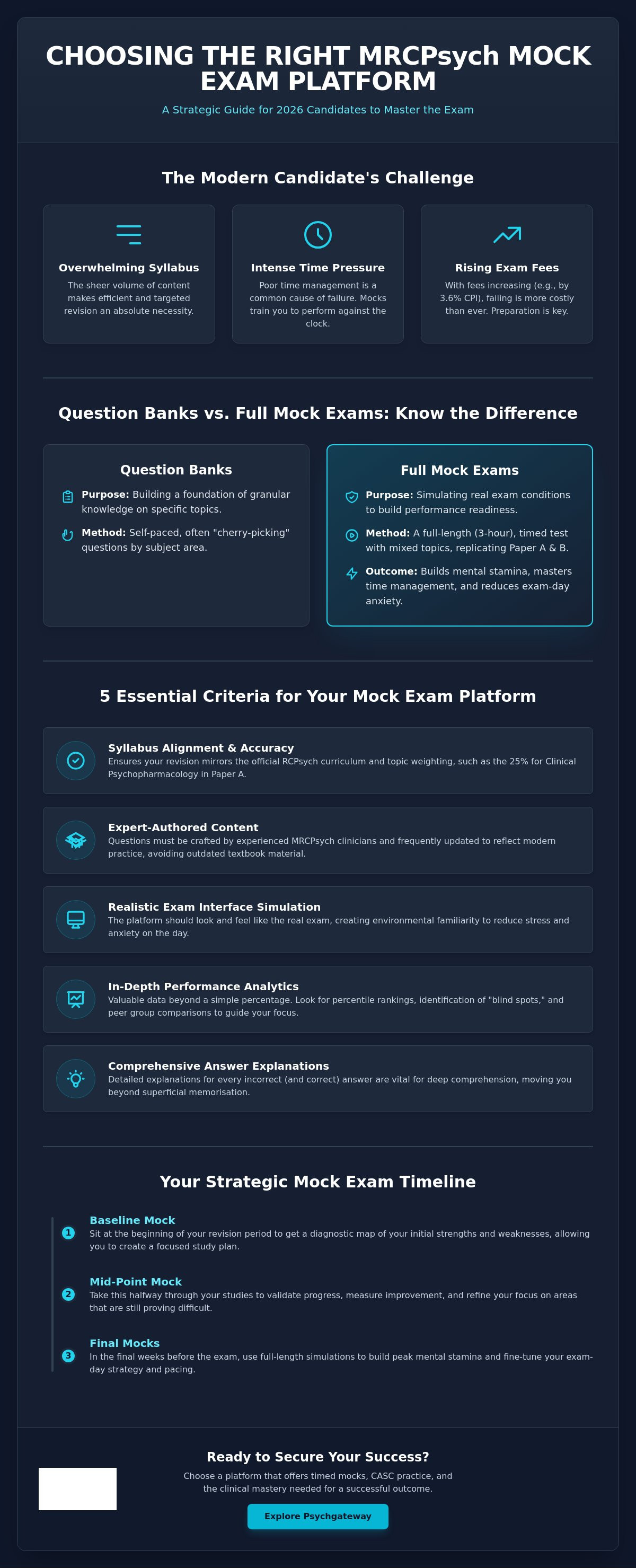
Selecting a revision resource is a significant investment of both time and professional focus. Not all platforms offer the same level of academic rigour or technical stability. A robust MRCPsych mock exam comparison must prioritise syllabus alignment above all else. Your chosen platform should mirror the official MRCPsych exam information provided by the Royal College to ensure your efforts aren't wasted on outdated material. This ensures that the weighting of topics, such as the 25% allocated to Clinical Psychopharmacology in Paper A, is accurately represented in your practice sessions.
Quality is often dictated by the expertise of the authors. Questions should be crafted by experienced MRCPsych clinicians who understand the nuances of the current curriculum. Static textbooks often contain "recycled" questions that no longer reflect modern psychiatric practice or the latest clinical guidelines. An effective digital platform refreshes its bank frequently to maintain clinical accuracy and relevance, providing a dynamic learning environment that a physical book simply cannot match.
Author Credentials and Content Integrity
Resources led by qualified specialists, such as those developed under the guidance of Dr Sidra Bukhari, offer a layer of professional integrity that generic question banks lack. These specialists ensure that Single Best Answer (SBA) and Extended Matching Item (EMI) formats are executed with the same level of complexity found in the real exam. It's not just about finding the right answer; it's about understanding why the distractors are incorrect. Look for platforms that provide exhaustive explanations for every option, as this depth is what builds true clinical mastery rather than superficial memorisation.
User Experience and Realistic Simulation
The technical interface is just as important as the content itself. The most effective mocks mimic the Pearson VUE software, allowing you to become familiar with the layout and navigation before the day of the sitting. Practising with a timed interface is the only way to master the pacing required to finish 150 questions within the three-hour limit. Whilst mobile accessibility is useful for quick revision on-call or during commutes, your primary mock attempts should be performed on a desktop to simulate official exam conditions accurately.
Beyond the written papers, consider how a platform supports your transition to the clinical component. Interactive CASC stations that allow for realistic practice are invaluable for those aiming for a first-time pass. If you're looking for a resource that meets these high standards, exploring the specialised tools at Psychgateway can provide the structured support you need for a successful 2026 attempt.
Online vs. Paper-Based Mocks: Which Format Wins in 2026?
The choice between digital platforms and traditional printed books is no longer just about personal preference. It's about technical alignment with the actual assessment process. In a thorough MRCPsych mock exam comparison, the logistical ease of a digital interface far outweighs the burden of carrying heavy textbooks. Digital platforms allow you to access your revision from any location, whether you're in a quiet study space or on a hospital break, ensuring consistency in your preparation schedule.
Beyond portability, the advantage of instant feedback is transformative for your learning curve. When you complete a timed mock online, you receive an immediate score breakdown and performance analysis. This automated marking saves hours of manual checking and allows you to pivot your focus to weak areas without delay. According to the Royal College of Psychiatrists exam information, the assessment format is computer-based, making digital familiarity a prerequisite for success rather than an optional extra. Practising in the same medium you'll be tested in is a fundamental principle of effective revision.
Simulating the Digital Exam Environment
Success in Paper A or Paper B depends on your tactical approach to the computer-based testing environment. Digital mocks allow you to practice the "flag and return" strategy, which is vital for managing your time across 150 questions. By getting comfortable with the screen layout during your mocks, you minimise your cognitive load on the day of the sitting. You can focus entirely on the clinical content rather than navigating the software. Additionally, the ability to use search functions within digital explanations facilitates rapid learning, helping you clarify complex psychiatric concepts in seconds.
The Limitations of Traditional Mock Books
Traditional mock books often struggle to keep pace with the rapidly evolving nature of psychiatric practice. They carry a significant risk of containing outdated statistics or older psychopharmacology guidelines that could lead to lost marks in a real exam scenario. Books also lack the interactive capability to provide peer-comparison data. Without knowing how other psychiatry trainees are performing on the same set of questions, it's difficult to gauge your actual readiness. This limitation is even more pronounced when preparing for the CASC, as a static text cannot simulate the dialogue flow or the pressure of a live clinical encounter. Whilst a one-off book purchase might seem cost-effective initially, a subscription to a modern platform provides better value through continuous updates and performance tracking.
Strategic Implementation: When to Sit Your Mock Exams
Treating a mock exam as a simple "pass or fail" indicator is a missed opportunity. To maximise your chances of success, you should view these simulations as diagnostic instruments that guide your entire revision trajectory. A thorough MRCPsych mock exam comparison reveals that the most effective platforms are those used strategically across different stages of preparation. Sitting a mock too late in your schedule leaves little room for corrective action, whilst sitting one too early without a plan can lead to unnecessary anxiety.
Your strategy should begin with a "Baseline Mock". Sitting a full paper before you start your main revision block provides a clear map of your existing psychiatric knowledge. It identifies which areas require intensive focus and which topics you've already mastered through clinical experience. Following this, a "Mid-Point Check" validates your study progress. If your scores haven't improved in specific domains, it's a signal to adjust your learning methods. Finally, the "Final Simulation" should take place seven days before the official date to refine your pacing and build the confidence needed for the actual sitting.
A Timeline for Paper A and Paper B Preparation
Successful candidates often allocate specific dates for full-length timed mock exams, treating them with the same gravity as the real event. One of the most effective techniques is the "Deep Dive" review. For every three-hour mock you sit, you should spend at least six hours analysing the explanations. This 2:1 ratio ensures you understand the clinical reasoning behind every distractor. Balancing these full papers with targeted revision in high-weighting areas, such as neurosciences or statistics, creates a well-rounded and resilient knowledge base. To begin your diagnostic journey, you can access the Timed Mock Exams at Psychgateway to establish your baseline today.
Preparing for the CASC: Mock Station Practice
The clinical component requires a different tactical approach. Strategic implementation for the CASC involves organising peer-review sessions that utilise realistic role-player briefs. Static reading isn't enough; you must engage in repeated interactive simulation to refine your communication skills. Focus on timed history-taking and ethics stations, as these often present the greatest challenge under pressure. By simulating the dialogue flow and time constraints of the actual circuit, you move from theoretical knowledge to clinical mastery, ensuring you're ready for the nuances of the 2026 assessment.
Why Psychgateway is the Preferred Choice for Timed Mocks
After evaluating the essential criteria in this MRCPsych mock exam comparison, it becomes clear that the quality of your revision tools directly influences your performance. Psychgateway is designed as a premium, specialised resource that prioritises clinical accuracy and candidate confidence. We don't just provide a database; we offer a structured curriculum led by experts. Our MRCPsych Paper A Question Bank and MRCPsych Paper B Question Bank are meticulously curated to build deep comprehension rather than superficial memorisation. Every question is authored by clinicians who possess an intimate understanding of the hurdles faced by psychiatry trainees.
Beyond the written papers, we provide a dedicated pathway for clinical success. Our CASC Practice Stations offer the interactive simulation necessary to master the dialogue flow and technical pressure of the final assessment. We understand that every trainee has a different schedule. To accommodate this, we offer flexible subscription lengths that suit your specific timeline, whether you're starting six months out or need an intensive final month of preparation. Our goal is to act as your dedicated ally, fostering a relationship built on trust and shared professional goals.
The Psychgateway Advantage: Accuracy and Empathy
We recognise the unique challenges faced by International Medical Graduates (IMGs) as they transition to the UK exam system. Our platform is designed with this in mind, offering clear guidance and detailed performance tracking. This data-driven approach ensures you are truly exam-ready by highlighting exactly where you stand against your peer group. To help you make an informed decision, you can start your journey with a three-day free trial. There is no credit card required, allowing you to explore our interface and content quality with complete peace of mind.
Final Checklist for Your Exam Resource Selection
As you finalise your preparation strategy for 2026, use this checklist to verify the quality of your chosen resources:
- Syllabus Breadth: Ensure the MCQ and EMI coverage spans the full RCPsych curriculum, including high-weighting topics like neurosciences.
- Timed Simulation: Confirm the platform offers realistic Timed Mock Exams that mimic the official computer-based testing environment.
- Mentor-Led Insight: Choose a resource led by specialists who prioritise your long-term success over generic volume.
- Actionable Feedback: Look for detailed explanations that clarify incorrect options to deepen your clinical reasoning.
Your membership is a significant professional milestone. Don't leave your result to chance by using inconsistent or outdated materials. Organise your revision today with Psychgateway and approach your next sitting with the composure and mastery required for success.
Securing Your Path to Membership
Your preparation for the 2026 sittings requires more than a high volume of questions; it demands a strategic approach to clinical mastery. This MRCPsych mock exam comparison has highlighted that success is built upon realistic simulation, rigorous syllabus alignment, and the diagnostic use of performance data. By choosing a platform that mirrors the Pearson VUE interface and offers clinician-led insights, you ensure your revision is both efficient and relevant to current standards.
Psychgateway provides a structured environment authored by Dr Sidra Bukhari, MRCPsych, with comprehensive coverage across Paper A, Paper B, and the CASC. Our timed mock exams are designed to build your mental stamina and reduce exam-day anxiety through environmental familiarity. Don't leave your professional future to chance with generic or outdated resources. Instead, utilise a specialist, mentor-led tool that prioritises your long-term success.
Start your 3-day free MRCPsych trial with Psychgateway
We're dedicated to supporting your journey toward membership. You have the clinical experience and the dedication required to succeed; we provide the precision tools to help you prove it. Approach your next sitting with the composure and confidence that comes from thorough, validated preparation.
Frequently Asked Questions
How many mock exams should I do before MRCPsych Paper A?
You should aim to complete at least three full-length simulations before your scheduled sitting. This sequence begins with a baseline mock to identify knowledge gaps, followed by a mid-point check to validate your progress. A final rehearsal one week before the exam date helps you refine your pacing. This structured approach builds the mental stamina required to remain focused throughout the three-hour assessment period.
What is a good score on an MRCPsych mock exam to ensure a pass?
Aiming for a consistent score of 70% or above is generally considered a safe margin for success. Whilst the official pass mark varies between diets, achieving this level in your MRCPsych mock exam comparison against peer averages indicates strong readiness. You should pay close attention to your percentile ranking, as this provides a more accurate reflection of your standing amongst other psychiatry trainees.
Are online MRCPsych mocks better than using textbooks?
Digital mocks are superior because they mirror the computer-based testing environment used in the actual exam. Online platforms offer automated marking, instant feedback, and performance tracking that physical books cannot provide. They also ensure you're practising with the most recent clinical guidelines and psychopharmacology data. Textbooks often contain outdated statistics and lack the interactive nature of Extended Matching Items found in modern assessments.
Can I practice CASC stations online effectively?
You can practice effectively by using interactive platforms that provide realistic role-player briefs and timed stations. Online simulations allow you to refine your communication skills and history-taking flow under pressure. This approach is particularly useful for trainees who need to organise peer-review sessions across different locations. Repeated interactive simulation helps move your preparation from theoretical knowledge to the clinical mastery required for the circuit.
How does Psychgateway ensure its mock exams are up to date?
Our content is led by MRCPsych-qualified clinicians who actively monitor changes in the RCPsych curriculum and NICE guidelines. We refresh our question banks and timed simulations regularly to reflect the latest evidence-based practice and exam trends. This meticulous specialist oversight ensures you don't waste time on outdated material. Every question is designed to align with current standards, providing a reliable resource for your final preparation.
Is there a free trial available for MRCPsych mock exams?
Psychgateway offers a three-day free trial that provides access to our interface and sample content. This allows you to experience the quality of our clinician-authored questions without any initial commitment or credit card requirement. It's an ideal way to validate the platform's suitability for your revision needs. You can explore our performance tracking tools and see how our explanations support deep comprehension of complex topics.
How do I manage my time during the 150-question Paper B exam?
You should allocate approximately 72 seconds per question to ensure you complete the paper within the three-hour limit. Use the "flag and return" strategy to skip complex items and secure marks on easier questions first. Practising with a timed interface is essential to master this pacing and reduce exam-day cognitive load. This tactical approach ensures you have enough time to review your answers before the session ends.
Do MRCPsych mock exams include the latest statistics and neurosciences questions?
High-quality mock exams must include these high-yield topics, as they represent a significant portion of the syllabus. In a detailed MRCPsych mock exam comparison, you'll find that premium platforms prioritise these areas to reflect official weighting. Our resources ensure you're prepared for the technical complexity of these specific domains. We provide detailed explanations for every answer to help you master the underlying principles of basic neurosciences and clinical psychopharmacology.