

What if the greatest hurdle to passing Paper B isn't the volume of information, but the fundamental shift in how you're required to think? Moving from the basic sciences of Paper A to the nuanced clinical application and rigorous statistics of Paper B often feels like a daunting leap. You're likely balancing heavy clinical rotas amongst your other professional commitments whilst trying to unpick complex research methodology and critical appraisal. It's a high-pressure environment where time is your most precious resource. We understand that this transition requires more than just memorisation; it demands a refined level of clinical judgement and analytical scrutiny.
By integrating high-quality MRCPsych Paper B practice exams into your routine, you can transform your revision from a source of anxiety into a structured path toward mastery. This article promises to show you how to utilise these tools to gain absolute confidence in tackling both EMIs and MCQs. We will preview a comprehensive revision plan designed to help you master evidence-based practice and clinical psychiatry, ensuring you're fully prepared for the 150-mark challenge ahead. Let's explore how to simulate the exam environment effectively and secure your success in the next diet.
Key Takeaways
- Understand the 150-question balance between critical review and clinical topics to allocate your revision time effectively.
- Utilise high-quality MRCPsych Paper B practice exams to map your knowledge against the full syllabus, focusing on high-yield areas like addictions and psychotherapy.
- Master the complex logic of Extended Matching Items (EMIs) by learning how to identify distractors and apply clinical judgement under pressure.
- Use timed mock exams to establish a performance baseline and create a structured revision plan based on your specific subspecialty weaknesses.
- Discover how expert-led question banks provide the depth and accuracy needed to transition from basic science to advanced clinical psychiatry.
Understanding the MRCPsych Paper B Landscape
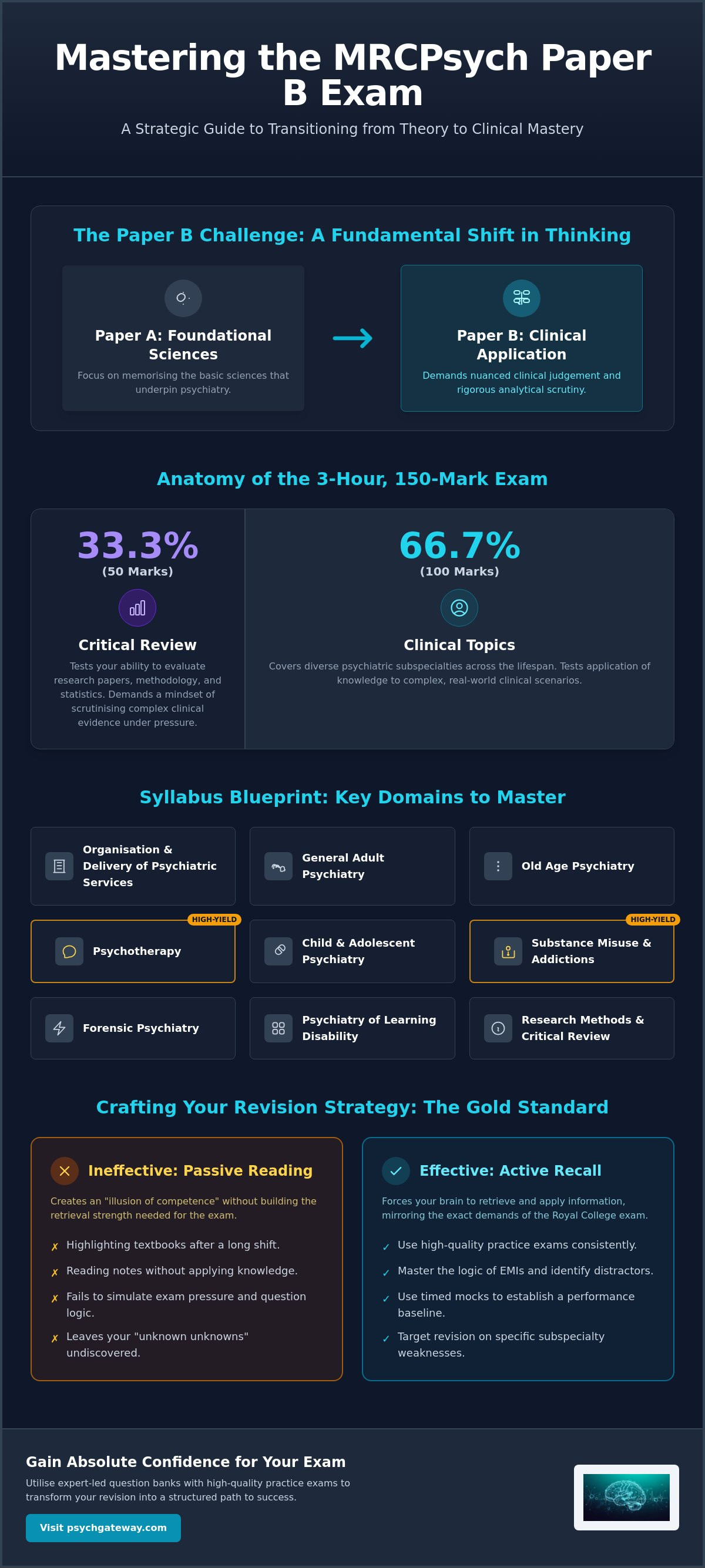
Paper B represents a significant pivot in your professional development. Whilst Paper A focused heavily on the foundational sciences, the Membership of the Royal College of Psychiatrists (MRCPsych) Paper B exam is designed to test your clinical application and critical scrutiny. It acts as the bridge between theoretical knowledge and the high-level expertise required for consultant practice. This three-hour assessment consists of 150 marks, requiring a sophisticated understanding of both evidence-based medicine and diverse psychiatric subspecialties. Success here isn't just about what you know; it's about how you apply that knowledge to complex, real-world scenarios.
The Core Components: Critical Review vs Clinical Topics
The exam structure is precisely weighted to reflect the dual demands of modern psychiatry. One-third of the paper (33.3%, or 50 marks) is dedicated to Critical Review, which encompasses research methodology and statistics. The remaining two-thirds (66.7%, or 100 marks) cover Clinical Topics across the psychiatry lifespan. This distribution demands a balanced revision strategy that doesn't neglect the mathematical rigour of research for the more familiar clinical narratives.
- Critical Review: Focuses on your ability to evaluate the validity and clinical relevance of research papers.
- Clinical Topics: Spans General Adult, Old Age, Child and Adolescent, Forensic, and Addictions psychiatry, amongst others.
The "Critical Review" mindset is the ability to scrutinise complex clinical evidence under intense time pressure. You must move beyond knowing what the evidence says to understanding how it was derived and whether it's robust enough to guide patient care.
Why Passive Reading Fails the Paper B Candidate
Many candidates fall into the trap of passive revision, spending hours highlighting textbooks or reading notes whilst exhausted after a long shift. This often creates an "illusion of competence." You feel familiar with the material, but you haven't developed the retrieval strength needed for the exam. Relying on standard textbooks alone is insufficient because they don't simulate the distractor logic or the specific Extended Matching Item (EMI) format used in the actual assessment.
Utilising MRCPsych Paper B practice exams is the only way to expose "unknown unknowns." You might feel confident in General Adult psychiatry but find yourself struggling with the specific legal frameworks in Forensic practice or the developmental milestones in CAMHS. Active recall is the gold standard for preparation. It forces your brain to retrieve information and apply it to clinical scenarios, which is exactly what the Royal College expects. Consistent engagement with high-quality MRCPsych Paper B practice exams ensures that your knowledge is not just stored, but accessible and ready for professional application.
Syllabus Mapping: What Your Practice Exams Must Cover
Effective revision begins with a clear understanding of the curriculum boundaries. Unlike the broad scientific principles of Paper A, Paper B demands a granular focus on clinical subspecialties and the organisational frameworks of the NHS. To ensure your preparation is targeted, your MRCPsych Paper B practice exams must align strictly with the Royal College of Psychiatrists exam preparation guide. This alignment ensures you aren't wasting time on outdated clinical practices or irrelevant international guidelines.
The syllabus is divided into several key domains that your practice questions must reflect:
- Organisation and Delivery of Psychiatric Services
- General Adult Psychiatry
- Old Age Psychiatry
- Psychotherapy
- Child and Adolescent Psychiatry (CAMHS)
- Substance Misuse and Addictions
- Forensic Psychiatry
- Psychiatry of Learning Disability
- Research Methods and Critical Review
Whilst General Adult Psychiatry forms the bedrock of the clinical paper, high-yield topics like Psychotherapy and Addictions often determine the margin between a pass and a fail. These areas require you to move beyond simple diagnosis; you must understand treatment modalities, therapeutic frameworks, and the long-term management of complex dependencies. Ensure your revision materials provide the depth required to distinguish between subtle clinical presentations in these specialised fields.
Clinical Subspecialties: From CAMHS to Old Age
CAMHS and Learning Disability questions present unique challenges, often focusing on developmental milestones and specific legal protections. Your practice exams should simulate the "best answer 1 of 5" format, where multiple options may seem plausible, but only one aligns with current best practice. It's also vital to use questions that reflect the latest UK legislation, including the Mental Health Act and Mental Capacity Act. Laws change; your practice questions must be current to avoid costly errors on exam day.
Mastering Research Methods and Statistics
Statistics often trigger the most anxiety amongst candidates. You aren't expected to be a mathematician, but you must be a competent critic. Practice questions should force you to interpret p-values, confidence intervals, and various trial designs within the context of a clinical abstract. Mastery comes from repeated exposure to data interpretation from tables and forest plots. If you find these concepts challenging, Psychgateway’s expert-authored explanations break down complex statistical hurdles into manageable, logical steps. This methodical approach ensures you can scrutinise clinical evidence with confidence, even under the strict time constraints of the actual exam.
The Anatomy of a High-Quality Paper B Practice Question
A practice question serves as more than just a knowledge check; it's a cognitive rehearsal for the high-stakes environment of the professional assessment. High-quality MRCPsych Paper B practice exams distinguish themselves by moving past simple factual recall to focus on clinical judgement. The Royal College employs a sophisticated "distractor" logic. These options aren't clearly incorrect but are instead plausible alternatives that might be appropriate in a slightly different clinical context. This design forces you to demonstrate precise diagnostic and management skills rather than relying on superficial recognition.
Specialist authorship is a critical factor in question quality. Questions written by those who have navigated the exam themselves carry a level of nuance that generic question banks lack. They understand the specific "traps" candidates often fall into and design vignettes to correct those specific misconceptions. This level of expert insight ensures that your preparation remains aligned with the actual difficulty level you'll face on exam day.
MCQs vs EMIs: Navigating the Format
The exam format comprises roughly two-thirds Multiple Choice Questions (MCQs) and one-third Extended Matching Items (EMIs). Whilst MCQs test individual clinical facts, EMIs require you to navigate a long list of potential options against several related vignettes. This structure tests your ability to differentiate between closely related conditions or treatments. To succeed, you must develop a systematic method for eliminating distractors. Read the vignette carefully for "key" descriptors that rule out similar options; often, a single word like "acute" or "chronic" changes the entire answer. EMIs test the depth of a candidate’s clinical categorisation skills by requiring them to apply a single list of options to diverse, nuanced scenarios.
The Power of Detailed Explanations
The value of a practice session lies in the "why" behind the answer. A question bank is only as effective as its feedback loop. High-quality resources ensure that every answer is accompanied by a thorough explanation that builds deep understanding. This approach moves you away from rote memorisation and toward a conceptual mastery of the subject matter. These explanations should ideally link back to the Royal College of Psychiatrists exam information to ensure your logic aligns with official expectations.
Effective performance tracking allows you to see exactly where your clinical logic is failing. By categorising your errors, you can organise your revision time to focus on subspecialties where your distractor-recognition skills are weakest. This data-driven approach ensures that every hour spent on MRCPsych Paper B practice exams contributes directly to your overall readiness and confidence.
Strategic Revision: How to Use Mock Exams Effectively
Establishing a clear baseline is the first step toward professional readiness. You should complete a full-length, timed mock exam at the very start of your revision cycle. This initial diagnostic provides a transparent overview of your current standing across the nine subspecialty categories. Rather than guessing where your weaknesses lie, you can use objective performance data to categorise your revision needs. This methodical approach ensures that your limited study time is directed toward the areas that will most significantly impact your final score.
Time management is a frequent point of failure for even the most knowledgeable candidates. In a three-hour window, you must navigate 150 questions, leaving you with approximately 72 seconds per item. This pace leaves no room for hesitation or protracted deliberation. Consistent engagement with MRCPsych Paper B practice exams trains your brain to process clinical vignettes rapidly and make decisive choices. Building this rhythm early prevents the panic that often sets in during the final 30 questions of the actual assessment.
Phase 1: Diagnostic Testing and Gap Analysis
Use your first 50 questions as a focused diagnostic tool to identify subspecialty blind spots. Many candidates discover they've unintentionally neglected areas like the Organisation and Delivery of Psychiatric Services whilst focusing on more familiar clinical topics. It's often beneficial to master the Critical Appraisal section early in your programme. Securing these marks builds a psychological cushion and boosts your confidence for the clinical sections that follow. Aim to integrate ten to fifteen practice questions into your daily clinical work, treating each one as a mini-consultation that requires a definitive management plan.
- Identify: Use data to pinpoint which of the 9 subspecialties require the most attention.
- Prioritise: Focus on high-yield topics where your performance is currently below 60%.
- Integrate: Make active retrieval a daily habit rather than a weekend-only activity.
Phase 2: Timed Simulation and Stamina Building
The cognitive load of a 150-question exam is immense. "Exam fatigue" is a genuine physiological hurdle that can lead to careless errors in the final hour. Full-length mock exams are essential for building the mental stamina required to maintain focus for the full 180 minutes. These simulations help you recognise the early signs of fatigue, such as misreading "except" or "least likely" in a question stem. To ensure your preparation is as realistic as possible, utilize Timed Mock Exams that replicate the digital environment and distractor logic of the Royal College. Replicating the Pearson VUE interface reduces anxiety on the day, allowing you to focus entirely on the clinical content.
Reviewing every answer is just as vital as the testing phase itself. Don't simply look at the questions you got wrong; scrutinise the ones you got right to ensure your logic was sound rather than a lucky guess. Reinforcing the underlying clinical reasoning for every correct choice solidifies your mastery and ensures you can replicate that success under the pressure of the real MRCPsych Paper B practice exams.
Why Psychgateway is the Definitive Choice for Paper B
Psychgateway stands as a premium resource because it bridges the gap between raw information and clinical application. Choosing the right revision tool is a decision that impacts your confidence as much as your knowledge. Dr Sidra Bukhari’s expert authorship provides a mark of professional integrity that distinguishes this platform from generic alternatives. Her intimate understanding of the hurdles faced by candidates ensures that every question in the MRCPsych Paper B practice exams reflects the actual difficulty and clinical depth required for success. You aren't just answering questions; you're engaging with a curriculum designed by a specialist who understands the nuances of the Royal College standards.
The platform's comprehensive nature ensures that no subspecialty is left unaddressed amongst the nine key categories. Whilst smaller providers might offer a superficial overview, Psychgateway provides a deep dive into the 150-question structure you'll face. For busy doctors, the user-friendly interface is specifically designed to reduce revision friction. It allows you to transition smoothly between clinical duties and active retrieval, making the most of every available minute in your schedule. It's a system built for efficiency, allowing you to focus on mastery rather than administrative hurdles.
Authored by Experts, Designed for Success
The commitment to accuracy means the content is always strictly aligned with the current Royal College syllabus. This focus is particularly vital for International Medical Graduates (IMGs) who might find the specific nuances of UK legislation or NHS service delivery challenging. By providing the most realistic exam simulation available, the platform helps you build the stamina needed for the three-hour window. You'll find that the distractor logic used here mirrors the actual exam, forcing you to refine your clinical judgement. You aren't just memorising facts; you're rehearsing the professional role of a consultant psychiatrist in a simulated environment.
Start Your Journey to MRCPsych Success
Your path to success begins with a clear understanding of your current performance. We encourage you to take the first step by utilising a diagnostic mock exam to identify your specific needs. The platform's mentor-led approach acts as a focused guide, valuing accuracy and depth above all else. It's about more than just passing; it's about validating your clinical expertise and preparing for long-term professional achievement. You don't need to guess your readiness when you have access to detailed performance tracking and expert-led explanations.
You don't have to navigate this high-pressure period alone. Experience the quality of our specialized resources firsthand with our three-day free trial. This allows you to explore the depth of our explanations and the precision of our MRCPsych Paper B practice exams risk-free. It's the most effective way to ensure your revision programme is on the right track.
Start your 3-day free trial of the MRCPsych Paper B Question Bank today and begin your structured path toward mastery.
Secure Your Path to Consultant Practice
Success in Paper B requires a decisive transition from factual recall to sophisticated clinical judgement. You now understand that mastering the 150-question structure and navigating the complex distractor logic of EMIs are essential steps in your professional development. Consistent engagement with high-quality MRCPsych Paper B practice exams ensures that you aren't just memorising the syllabus, but validating your ability to apply it under intense time pressure. This methodical approach transforms your revision from a source of anxiety into a structured path toward mastery.
Psychgateway offers a comprehensive, syllabus-aligned question bank authored by Dr Sidra Bukhari, MRCPsych. Our platform provides realistic timed mock exam simulations that prepare you for the cognitive load of the 3-hour assessment, ensuring you're ready for every clinical scenario. You've dedicated years to your medical training; don't leave your final results to chance. Use the tools designed by specialists who understand the unique hurdles of this postgraduate milestone.
Master Paper B with our expert-led practice exams; start your free trial now. Take the first step today and approach your exam with the confidence and composure of a seasoned specialist.
Frequently Asked Questions
How many questions are in the MRCPsych Paper B exam?
The MRCPsych Paper B exam consists of 150 questions to be completed within a three-hour window. The paper is worth a total of 150 marks and follows a structured format of approximately two-thirds multiple-choice questions (MCQs) and one-third extended matching items (EMIs). This distribution ensures a comprehensive assessment of both individual clinical facts and complex diagnostic reasoning.
Is Critical Appraisal the hardest part of Paper B?
Critical Appraisal is frequently cited by candidates as the most challenging component because it requires a shift from clinical intuition to mathematical rigour. It accounts for exactly one-third of the marks, covering research methodology and statistics. Success in this section depends on your ability to scrutinise evidence and interpret data under pressure, which is why it requires dedicated, focused preparation.
How much time should I spend on each question during the exam?
You should aim to spend approximately 72 seconds on each question to ensure you complete the paper within the 180-minute limit. Maintaining this steady pace is vital for managing the 150-question load without experiencing late-stage fatigue. Regularly using MRCPsych Paper B practice exams allows you to internalise this rhythm and develop the decisiveness needed for the actual assessment.
Can I pass Paper B using only practice exams?
While MRCPsych Paper B practice exams are the most effective tool for active retrieval, they are most successful when integrated with a review of the official syllabus. Practice questions identify your "unknown unknowns" and refine your exam technique, but they shouldn't replace foundational reading in complex subspecialties. Use them as a diagnostic guide to ensure your clinical logic aligns with Royal College standards.
What is the difference between Paper A and Paper B revision?
Paper A revision focuses on the basic sciences and theoretical foundations, whereas Paper B is centred on clinical application and critical review. You must move beyond simple memorisation and demonstrate the clinical judgement expected of a senior trainee. The focus shifts toward evidence-based practice, service organisation, and the nuanced management of patients across the diverse psychiatric subspecialties.
How does Psychgateway help with the Critical Review section?
Psychgateway simplifies the Critical Review section by providing expert-led explanations for every statistical and methodological question. Our platform breaks down complex concepts like p-values and forest plots into logical, manageable stages. This approach builds deep comprehension rather than superficial recognition, ensuring you can interpret clinical abstracts with confidence during the exam.
Are the practice exams on Psychgateway updated for the 2026 syllabus?
Yes, all our materials are strictly aligned with the current syllabus required for the 2026 exam diets. While the Royal College has announced a syllabus update for 2027, candidates sitting the exam in 2026 must continue to use the current curriculum. We ensure our questions reflect the most recent UK legislation and clinical guidelines to provide the most accurate simulation possible.
Do I need a credit card to start the free trial?
You don't need to provide any credit card or payment details to access our three-day free trial. We offer this risk-free period so you can experience the quality of our specialist-authored questions and user interface firsthand. It's a transparent way to ensure our platform meets your revision needs before you make any professional commitment.