

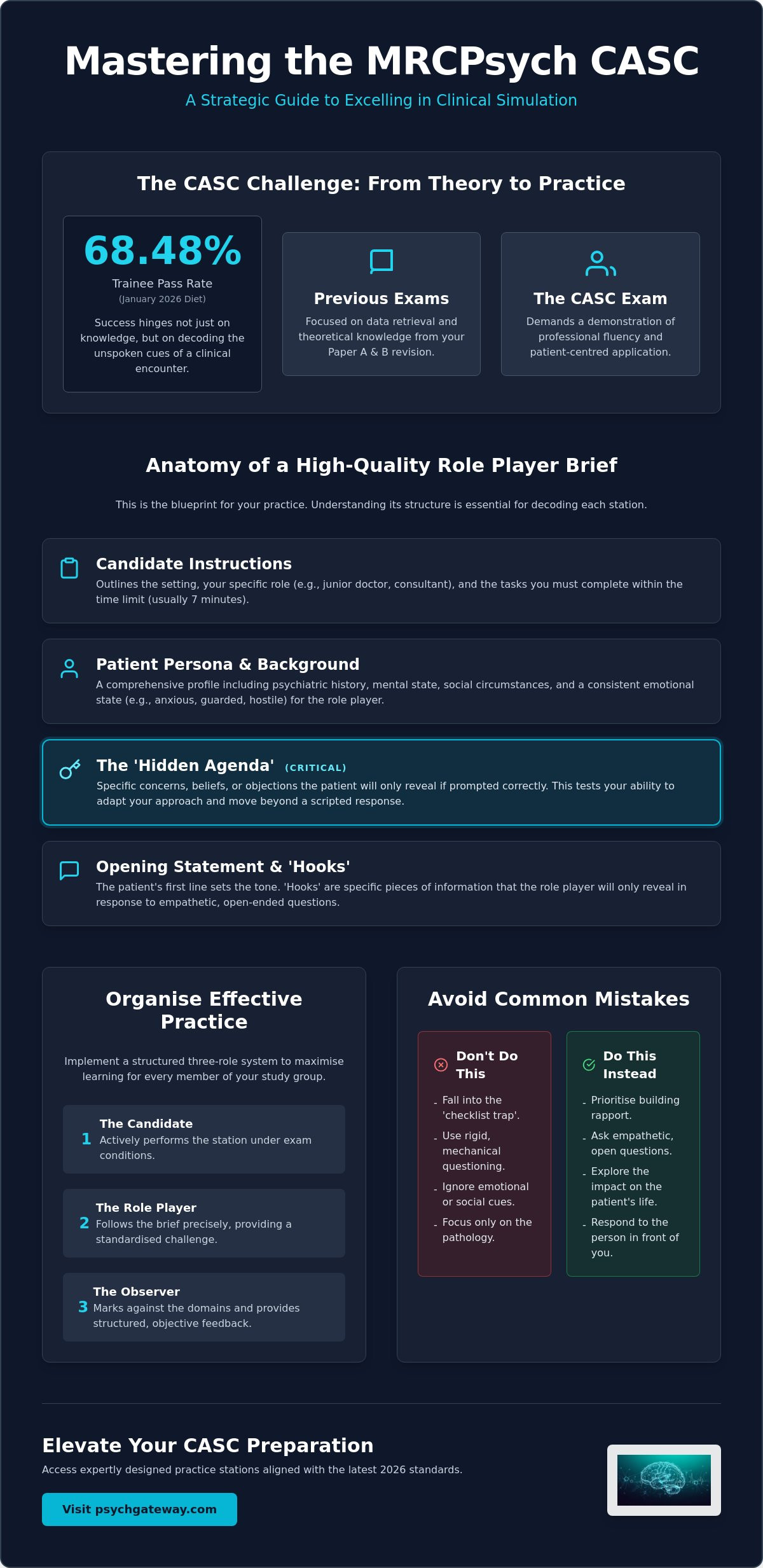
Why do candidates with impeccable clinical knowledge still struggle to pass the CASC when the trainee pass rate for the January 2026 diet was 68.48%? The challenge usually isn't a lack of psychiatric expertise, but rather an inability to decode the subtle, unspoken cues embedded within the station. You've likely felt that familiar anxiety during the 90-second reading time, wondering if you've missed the hidden agenda that could make or break your seven-minute encounter.
We understand that finding realistic, high-quality practice materials is often the biggest hurdle in your preparation. This guide provides a structured framework for utilising CASC role player briefs to master the art of clinical simulation. You'll learn how to identify the specific emotional hooks examiners look for and gain the confidence to manage complex role player behaviours with professional composure. By focusing on deep comprehension rather than superficial memorisation, you can transform your practice sessions into precise rehearsals for your upcoming CASC attempt.
Key Takeaways
- Understand the transition from theory-based learning to clinical simulation by identifying the hidden agendas within each scenario.
- Discover the anatomy of high-quality CASC role player briefs, ensuring you can navigate both candidate instructions and detailed patient backgrounds with precision.
- Implement a structured three-role practice system to maintain realism and ensure every member of your study group gains maximum value.
- Learn to avoid common pitfalls, such as the 'checklist trap', by prioritising emotional cues and professional rapport over rigid questioning.
- Access expertly designed practice stations that align with the latest 2026 standards to ensure your preparation is both thorough and validated.
Understanding the Role of CASC Role Player Briefs in Your Revision
Success in the MRCPsych exams requires a significant shift in mindset as you move from written papers to the clinical circuit. Whilst your previous revision focused on data retrieval, the CASC demands a demonstration of professional fluency. It is essentially an Objective Structured Clinical Examination (OSCE), a format designed to test your clinical competence in a simulated environment. To bridge the gap between knowing a diagnosis and managing a patient, you must understand how to use CASC role player briefs effectively. These documents are the blueprint for your practice, providing the necessary constraints and cues that turn a simple conversation into a rigorous assessment.
Standardised briefs ensure that every practice session is a valid representation of the exam. Without a high-quality brief, peer feedback often becomes subjective and inconsistent. A well-constructed brief contains 'hidden' elements; specific emotional triggers or social complications that you won't find in a textbook. These elements test your ability to respond to the person, not just the pathology. By using professional CASC role player briefs, you ensure that your preparation remains aligned with the official standards of the Royal College of Psychiatrists, allowing you to refine your behaviour in a controlled, predictable way.
From Paper A and B to the Clinical Circuit
Your MRCPsych Paper A question bank preparation provided the pharmacological and neuroscientific foundation you needed to reach this stage. However, the CASC is not a finish line for theory. It's an arena for application. You must translate complex facts into patient-centred management plans that a layperson can understand. This requires maintaining academic rigour whilst adopting a supportive, empathetic tone. It is no longer enough to list symptoms; you must explore their impact on the individual's life.
The Purpose of the Role Player in CASC Assessment
Role players are not just there to provide answers to your questions. They are trained to provide a standardised challenge for every candidate, ensuring fairness across the circuit. Each role player works from a detailed script that dictates their behaviour, eye contact, and emotional reactivity. They respond to specific prompts; if you fail to ask the right question or use the correct tone, they may withhold vital information. This simulation tests your ability to build rapport and extract history under time pressure, mirroring the high-stakes environment you'll face in the 2026 diets.
The Anatomy of a High-Quality Role Player Brief
A high-quality brief is the foundation of any successful clinical simulation. During your 90-second or 4-minute reading time, you'll encounter the candidate instructions. These outline the setting, your role, and the specific tasks required. However, the true depth of the station lies within the role player's documentation. Effective CASC role player briefs provide a comprehensive background, covering the patient's psychiatric history, current mental state, and social circumstances. This ensures the simulation remains consistent and challenging for every candidate, regardless of their prior experience.
The 'Hidden Agenda' is perhaps the most critical component. This consists of specific concerns or objections that the patient must raise during the encounter. It tests your ability to adapt your clinical plan in response to patient preferences rather than following a rigid script. The opening statement sets the immediate tone; a patient who starts with "I don't even know why I'm here" requires a very different approach than one who is overtly distressed. To ensure your practice matches the real exam, it's helpful to use professionally structured CASC practice stations that mirror these complexities.
Constructing the Patient Persona
A brief must define the patient's emotional state with precision. Whether they are anxious, guarded, or hostile, the role player needs a consistent 'voice' and vocabulary to remain in character. This persona includes 'hooks' that you must actively seek out. A hook is a specific piece of information the role player only reveals if the candidate asks an empathetic, open-ended question. If you rely on a mechanical checklist, these vital clues will remain hidden, likely impacting your final score.
The Examiner's Mark Sheet Integration
The most effective briefs are designed with the Official CASC Exam Information in mind. They align directly with RCPsych grade descriptors, ensuring that the role player's actions provide you with the opportunity to demonstrate 'Excellent' criteria. For example, if the mark sheet requires a demonstration of 'sensitivity to the patient's perspective', the brief will include a specific social complication that demands an empathetic response. Prompting instructions also guide the role player on when to provide more information, ensuring the challenge remains standardised across different practice sessions.
How to Organise Effective CASC Practice Using Role Player Briefs
Organising your practice sessions with precision is as important as the content you study. To get the most out of CASC role player briefs, you must establish a disciplined environment that replicates the high-pressure conditions of the actual exam circuit. This structure prevents practice from descending into casual conversation and ensures every minute spent contributes to your clinical fluency. Follow these five steps to maximise your group revision:
- Step 1: Organise your group into three roles. Assign one person as the Candidate, one as the Role Player, and one as the Examiner. Rotate these roles frequently so everyone understands the station from every perspective.
- Step 2: Adhere to strict reading times. Use a stopwatch to allow exactly 90 seconds or 4 minutes for reading the candidate instructions. This simulates the transition period between stations where anxiety often peaks.
- Step 3: Respect the 'Wall'. Once the station begins, the role player must not break character until the buzzer sounds. Don't stop to clarify clinical facts or ask for help mid-flow.
- Step 4: Conduct the full 7-minute station. Resist the urge to finish early if you feel you've covered the main points. The final minutes are often where candidates demonstrate the depth required for an 'Excellent' grade.
- Step 5: Facilitate structured feedback. Use the final few minutes to review the brief's objectives. Avoid vague praise; focus on specific behaviours and whether the hidden agenda was successfully uncovered.
Tips for the Peer Role Player
Your goal is to be a realistic simulation, not an obstacle. Avoid being 'too helpful' by volunteering information the candidate hasn't earned through empathetic questioning. Conversely, don't be unnecessarily difficult unless the brief specifically describes a hostile persona. Use non-verbal cues to signal emotional states. If the brief describes a patient with low mood, avoid eye contact and speak with a restricted prosody. If the persona is anxious, fidget or look frequently at the door to prompt the candidate to address your discomfort.
The Examiner Role in Peer Practice
The examiner is the guardian of the station's integrity. You must monitor the time accurately and provide the 1-minute warning clearly. Use the mark sheet provided in the CASC role player briefs to offer objective feedback. Rather than saying "that was good", identify exactly which 'missed opportunities' occurred. Did the candidate ignore a social cue? Did they fail to address the patient's specific objection? This level of granular detail is what transforms a standard practice session into elite-level preparation.
Avoiding Common Mistakes When Practising with Role Player Briefs
Many candidates fail to pass the CASC not because they lack clinical knowledge, but because their practice sessions don't mirror the exam's rigour. A frequent error is the use of 'perfect' patients. If your peer role player is too compliant or volunteers information too easily, you aren't developing the persistence required for the real circuit. High-quality CASC role player briefs should include specific instructions for the patient to be slightly guarded or distracted, forcing you to earn the data you need. Don't let your practice sessions become comfortable conversations; they should be challenging simulations that test your professional boundaries.
Another common pitfall is breaking character mid-flow. Whilst it's tempting to stop the clock when a peer struggles, doing so prevents the development of the resilience needed for the actual exam circuit. You must respect the buzzer. Similarly, many trainees neglect the physical examination and mental state examination (MSE) components. They focus entirely on history taking, forgetting that CASC role player briefs often require a structured MSE or a verbal description of physical findings. Neglecting these areas ensures you miss straightforward marks that are essential for a passing grade.
The Danger of 'Checklist Medicine'
Following a rigid list of questions often leads to a 'Fail' in communication. When you prioritise a checklist over the person sitting in front of you, you miss the subtle emotional cues that signal the 'hidden agenda'. Success requires a delicate balance between data collection and the maintenance of a therapeutic alliance. Use your practice briefs to refine your active listening skills under time pressure. If the patient mentions a social stressor, acknowledge it immediately rather than moving to the next item on your mental list. This responsiveness is what examiners categorise as 'Excellent' behaviour.
Managing Difficult Behaviours in Simulated Stations
You must prepare for stations that involve angry, non-communicative, or overtly distressed patients. Maintaining professional composure amongst high-intensity role play is a skill that requires repeated exposure. Practise with briefs that specifically task the role player with being difficult or dismissive. This allows you to develop reliable strategies for de-escalation within the seven-minute limit. Focus on your non-verbal communication, tone of voice, and the use of validating statements to regain control of the encounter without appearing confrontational.
To ensure your preparation is as realistic as possible, access our CASC Practice Stations to avoid these common pitfalls and refine your clinical approach before the September 2026 diet.
Elevate Your Clinical Skills with Psychgateway’s CASC Practice Stations
Mastering the circuit requires more than clinical knowledge; it demands immersion in high-fidelity simulations. Psychgateway’s CASC Practice Stations offer a curated environment where theory meets professional application. Every station is underpinned by expertly crafted CASC role player briefs that align with the latest 2026 Royal College standards. By using these resources, you move beyond the simple retrieval of facts. You begin to develop the muscle memory needed to manage 16 independent stations with composure. This structured approach is vital for maintaining the professional integrity required to pass the final stage of your MRCPsych journey.
Our platform is designed by Dr Sidra Bukhari, MRCPsych. This ensures every scenario reflects the nuanced challenges of the actual exam. These interactive stations simulate the intense pressure of the morning and afternoon circuits, helping you build the necessary stamina for a full day of assessment. You'll find detailed explanations for every station, including model dialogues that demonstrate how to handle the 'hidden agendas' discussed earlier. This allows you to transition from basic practice to clinical mastery. This focused approach prepares you for the unique demands of the Sheffield diet in September 2026, where pass rates demonstrate significant variability.
Why Specialised Resources Make the Difference
Free, unverified briefs found online often lack the depth required for postgraduate assessment. They may miss the emotional triggers or social complications that are central to a passing grade. Using poor-quality materials can lead to a false sense of security, which is a risk you can't afford. Psychgateway ensures your practice covers the full breadth of the CASC blueprint, from elderly psychiatry to complex forensic scenarios. We provide expert-led feedback that builds a deep understanding of what examiners truly value. This validation is essential for candidates aiming for an 'Excellent' descriptor rather than just a borderline pass.
Start Your CASC Preparation Journey Today
Register for a free trial to explore our interactive clinical stations and see the quality of our CASC role player briefs firsthand. You'll join a community of successful candidates who have trusted Psychgateway to guide them through their MRCPsych exams. Don't leave your success to chance when the stakes are so high. The application deadline for the September diet is 3:30 pm on Friday, 26 June 2026; now is the time to solidify your revision strategy. Explore Psychgateway’s CASC Practice Stations and start your free trial today to ensure you're fully prepared for the 2026 circuit.
Master the Circuit for the 2026 CASC
Success in the clinical assessment requires a shift from passive study to active, disciplined simulation. You've seen how understanding the intricate anatomy of CASC role player briefs allows you to uncover hidden agendas and respond to emotional cues with professional fluency. By establishing a rigorous practice environment and avoiding the common pitfalls of rigid checklists, you can refine the empathetic communication style that examiners prioritise. This structured preparation is what separates a borderline attempt from a confident pass.
Our platform provides the specialised resources needed to bridge the gap between theory and practice. These interactive clinical simulation tools are authored by Dr Sidra Bukhari, MRCPsych, and remain strictly aligned with the official Royal College syllabus. They offer the precision required to navigate the 16 independent stations with composure. Start your 3-day free trial of Psychgateway’s CASC Practice Stations and begin your journey toward clinical mastery today. You've worked hard to reach this final stage; we're here to help you cross the finish line with confidence.
Frequently Asked Questions
What are CASC role player briefs?
CASC role player briefs are structured instructional documents that define the patient's psychiatric history, current mental state, and social context for a clinical simulation. They act as a script for the actor, ensuring that every candidate faces a standardised challenge. By providing specific emotional cues and hidden agendas, these briefs transform a simple clinical scenario into a rigorous assessment of your communication and professional behaviour.
How can I find realistic CASC practice stations online?
Professional online platforms like Psychgateway offer validated CASC practice stations that are specifically designed for the 2026 exam format. These resources are authored by experienced psychiatrists who understand the current RCPsych syllabus. Utilising these platforms ensures you have access to high-quality materials that include model dialogues and detailed marking descriptors, allowing you to move beyond superficial memorisation toward clinical mastery.
Can I write my own CASC role player briefs for my study group?
Whilst you can create your own scenarios, it's challenging to replicate the specific 'hooks' and marking criteria found in official examinations. Professional CASC role player briefs are meticulously structured to ensure they allow candidates to demonstrate 'Excellent' descriptors. Using unverified or self-written materials often results in a lack of objectivity, which can lead to a false sense of security during your revision sessions.
How much reading time do I get for CASC stations in 2026?
In the 2026 exam format, candidates are typically provided with 90 seconds of reading time before each seven-minute station begins. This brief window is designed to test your ability to synthesise information and plan your approach under significant pressure. It's essential to practice this transition frequently to ensure you can identify the station's primary task and prepare your opening statement with composure.
Is it better to practice with professional actors or fellow trainees?
Practising with fellow trainees is a cost-effective way to build foundational knowledge and clinical fluency. However, trainees often find it difficult to maintain the 'wall' or can be inadvertently too helpful. Professional actors, or high-quality simulation tools, provide a more realistic challenge by strictly adhering to the patient persona. This exposure is vital for developing the resilience needed to manage difficult or non-communicative behaviours.
What happens if the role player in the real CASC exam is difficult?
If a role player appears difficult or non-communicative, it's usually a deliberate challenge embedded within the station to test your de-escalation skills. Don't become defensive or frustrated; instead, acknowledge their emotional state and adapt your questioning style. Use validating statements and maintain a supportive tone to build rapport. Examiners prioritise your ability to manage these complex interactions whilst ensuring the patient remains at the centre of care.
How do examiners use the role player brief to mark my performance?
Examiners mark your performance against a structured sheet that is directly aligned with the role player's instructions. They look for specific behaviours, such as how you handle the 'hidden agenda' or whether you respond to the patient's social cues. Your score is determined by how effectively you meet these objectives whilst demonstrating the professional integrity and safety standards expected of a senior psychiatric trainee.
Are the CASC stations different for international medical graduates (IMGs)?
The CASC stations are identical for all candidates, including international medical graduates and UK-trained doctors. Every candidate must pass through the same 16 independent stations in an Objective Structured Clinical Examination format. The Royal College of Psychiatrists maintains a single standard of assessment to ensure fairness and professional competence across the entire psychiatric workforce, regardless of where an individual completed their initial medical training.