

Your MRCPsych Paper A question bank should be a teaching tool, not just a testing tool, if you intend to pass the first time. Many trainees find that reading textbooks alone leads to information overload, leaving them ill-prepared to apply basic neurosciences to complex clinical scenarios. It's frustrating to spend hours studying only to feel your confidence dip when faced with the 150 questions and three-hour stamina required for the July 9, 2026 exam.
We understand the pressure of balancing clinical rotations with the need for deep comprehension. This guide will show you how to leverage a high-quality question bank to master the 2026 syllabus and secure your membership. You'll discover a structured revision plan that focuses on high-yield topics like psychopharmacology, whilst learning how to benchmark your progress against other candidates. By the end of this article, you'll have the framework needed to approach your revision with professional composure and clinical readiness.
Key Takeaways
- Master the three-hour exam structure by understanding the critical balance between Multiple Choice Questions and Extended Matching Items.
- Focus your revision on high-yield topics like neurosciences and psychopharmacology, which together account for half of the available marks.
- Optimise your preparation with an MRCPsych Paper A question bank that emphasises deep comprehension and detailed rationales over superficial rote learning.
- Develop the mental stamina required for success by integrating timed mock exams and performance analytics into your weekly study schedule.
- Gain confidence through expert-led content that aligns precisely with the latest Royal College of Psychiatrists syllabus standards for 2026.
Understanding the MRCPsych Paper A Syllabus and Question Formats
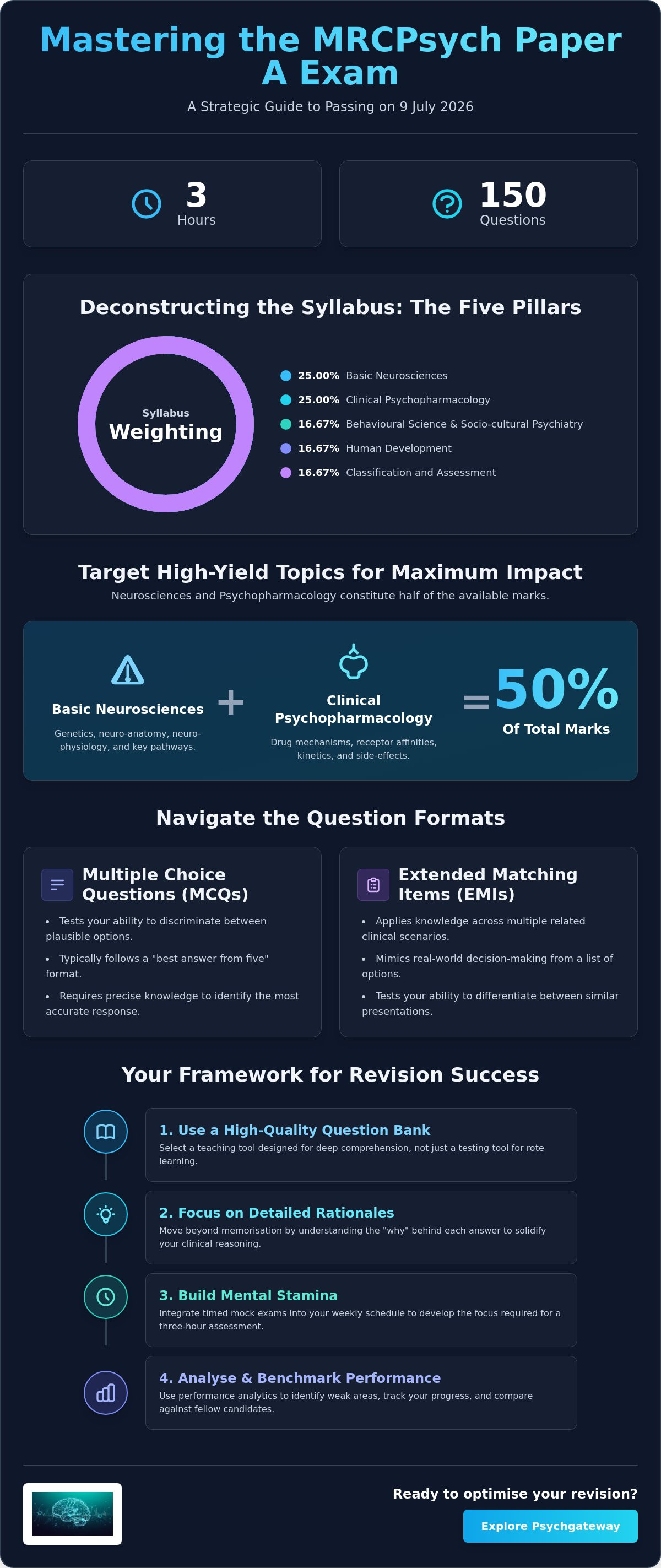
Entering the examination hall, whether physical or virtual, requires more than just clinical intuition. Paper A serves as the foundational assessment for the Membership of the Royal College of Psychiatrists, shifting the focus away from day-to-day ward work toward the rigorous scientific and theoretical underpinnings of the field. You'll face 150 questions over three hours, a test of both intellectual depth and mental stamina. Success isn't merely about how much you've read. It's about how well you've adapted your study habits to the specific weighting of the syllabus.
The Five Pillars of Paper A
The Royal College divides the assessment into five distinct domains. Whilst it's tempting to focus on areas you find naturally interesting, a strategic approach requires respect for the official percentages. The syllabus is structured as follows:
- Behavioural Science and Socio-cultural Psychiatry: 16.67%
- Human Development: 16.67%
- Basic Neurosciences: 25.00% (covering genetics, neuro-anatomy, and physiology)
- Clinical Psychopharmacology: 25.00% (focusing on drug mechanisms and kinetics)
- Classification and Assessment: 16.67%
Basic Neurosciences and Clinical Psychopharmacology are often the most daunting sections for candidates. They require a shift from clinical empathy to molecular precision. Genetic inheritance patterns, receptor affinities, and neuro-anatomical pathways aren't easily mastered through passive reading. Using an MRCPsych Paper A question bank that organises content by these pillars helps you identify your weakest areas early, turning abstract concepts into manageable blocks of knowledge. You can't afford to leave 50% of the marks to chance.
MCQs vs EMIs: Navigating the Format
The question formats are designed to test different levels of cognitive processing. Multiple Choice Questions (MCQs) typically follow the "best answer 1 of 5" format. These aren't always straightforward. Examiners often include distractors that are plausible but technically incorrect in the specific context provided. You must identify the most appropriate option amongst several strong candidates. MCQs aren't just about memory; they're about discrimination.
Extended Matching Items (EMIs) require you to apply your knowledge across a series of related scenarios. These test your ability to differentiate between similar clinical presentations or pharmacological choices. This format mimics real-world clinical decision-making, where you must choose from a long list of potential diagnoses or treatments for different patients. To reduce friction on the day, Psychgateway mirrors the official Royal College interface. This ensures you're familiar with the digital environment well before the clock starts ticking, allowing you to focus entirely on the clinical content rather than the software. Practice within a representative MRCPsych Paper A question bank ensures that the technical format becomes second nature, leaving your mental energy free for the questions themselves.
Targeting High-Yield Topics: Neurosciences and Psychopharmacology
Neurosciences and Psychopharmacology represent the scientific core of the exam. Together, they constitute 50% of the total marks available. Whilst other sections focus on social and developmental aspects, these domains require a deep dive into biological mechanisms and molecular precision. It's common for trainees to feel overwhelmed by the sheer volume of neuro-anatomy or the intricacies of genetic inheritance. However, neglecting these high-yield topics is a risk that often leads to disappointment on results day. You must move beyond superficial reading to achieve true mastery.
Mastering Basic Neurosciences
Functional anatomy is more than just naming structures. You need to understand how pathways like the mesolimbic and nigrostriatal systems correlate with both clinical symptoms and medication side effects. Genetics also poses a unique hurdle. You'll need to be comfortable with heritability coefficients and the specific findings from landmark twin studies. Academic institutions, such as those involved in UCL's MRCPsych preparation course, highlight the necessity of this foundational knowledge for postgraduate success. Using a focused MRCPsych Paper A question bank allows you to isolate these sub-topics. This ensures you don't just "read" about neurophysiology but actually apply it to the rigorous scenarios favoured by examiners.
Clinical Psychopharmacology Essentials
This domain demands absolute precision. You aren't just learning what a drug does; you're learning how it moves through the body and interacts with other substances. To succeed, you should structure your revision around these key areas:
- Mechanisms of Action: Prioritise the receptor affinities for all major classes, including antipsychotics, antidepressants, and mood stabilisers.
- The Cytochrome P450 System: Master the common inducers and inhibitors. Drug-drug interactions are a frequent theme in Extended Matching Items (EMIs).
- Pharmacokinetics vs Pharmacodynamics: Understand the difference between what the body does to the drug and what the drug does to the body, specifically regarding half-lives and steady-state concentrations.
Practising EMIs is vital here. These questions challenge your ability to select the most appropriate medication when multiple options seem viable. If you find your scores lagging in this area, it's a sign to revisit your pharmacodynamics. You can refine your approach by using the MRCPsych Paper A question bank to drill into specific drug classes until the mechanisms become intuitive. Identifying these weak spots early prevents the "exam-day panic" that occurs when faced with complex prescribing scenarios.
Beyond Rote Memorisation: How to Organise Your Revision Strategy
A common mistake amongst candidates is the "binge-testing" trap. This involves racing through as many questions as possible whilst neglecting the deeper context. Simply seeing a high volume of content doesn't equate to clinical readiness. True mastery of the MRCPsych Paper A question bank requires a shift from passive recognition to active recall. If you find yourself clicking through answers without pausing to digest the reasoning, you're likely memorising specific questions rather than learning the underlying principles of the Official MRCPsych Paper A Syllabus.
To build the mental stamina required for a three-hour assessment, you should organise your study sessions into timed blocks. Start with 45-minute intervals of focused work, followed by short breaks. This methodical approach mirrors the pace of the actual exam and prevents the cognitive fatigue that often leads to careless errors. Use "Revision Mode" during these sessions. This feature provides immediate feedback on every choice, allowing you to correct misconceptions in real time. Understanding why a distractor is incorrect is just as vital as knowing the right answer. These "near-miss" options are carefully crafted to test the boundaries of your knowledge and clinical judgement.
The Power of Detailed Explanations
Every question within the Psychgateway bank is accompanied by a comprehensive rationale. These aren't generic summaries; they're precise academic insights authored by Dr Sidra Bukhari, MRCPsych. This ensures that every explanation meets the high standards of the Royal College. Whilst revising, try to summarise these rationales in your own words. This active learning technique forces your brain to process the information more deeply, making it easier to recall during high-pressure moments. Don't just accept the correct answer; interrogate the logic behind it to ensure deep comprehension.
Spaced Repetition and Performance Tracking
A structured plan must include a mechanism for revisiting difficult material. Flag questions that you find challenging or those where you guessed correctly by chance. Spaced repetition ensures these topics return to your queue at optimal intervals, reinforcing your memory. You should also track your performance across different syllabus domains. If your scores in Behavioural Science are consistently higher than in Neurosciences, it's time to rebalance your focus. For those needing additional support in the biological domains, check our High-Yield Neurosciences Revision for Paper A for deeper dives into complex anatomy and genetics. This data-driven approach ensures even coverage and eliminates blind spots in your preparation.
Simulating Success with Timed Mock Exams and Performance Data
Developing a deep theoretical understanding is only half the battle. To truly gauge your readiness, you must transition from topical study to full-scale simulation. A high-quality MRCPsych Paper A question bank should provide more than just isolated practice; it must offer a realistic preview of the 180-minute pressure cooker you'll face. Without timed practice, even the most knowledgeable candidates risk running out of time during the final section of the paper. Success in this environment requires a blend of clinical knowledge and disciplined time management.
How to Use Mock Exams Effectively
To gain the most value from your practice, follow a structured protocol designed to mirror the actual exam day:
- Step 1: Complete a full 150-question mock in a quiet, exam-like environment. Avoid all distractions to build the concentration levels required for the actual day.
- Step 2: Review your performance report immediately. Identify syllabus gaps where your scores fall below your target average or where you feel hesitant.
- Step 3: Re-read the rationales for every question you got wrong or marked as a "guess". This ensures you aren't relying on luck for your marks.
- Step 4: Compare your score to the average pass mark amongst our national cohort using the candidate histogram.
Analyse your "time per question" metric with precision. If you're spending more than 70 seconds on initial Multiple Choice Questions, you might struggle with the more complex Extended Matching Items later in the paper. Psychgateway mocks simulate the exact distribution of questions used by the College, ensuring your practice is both representative and rigorous. This data-driven approach allows you to adjust your pace before it impacts your final score.
Reducing Exam-Day Anxiety
Anxiety often stems from the unknown. Familiarity with the digital interface reduces cognitive load on the day, allowing you to focus entirely on the clinical content. By using Psychgateway's Timed Mock Exams, you develop a natural rhythm for the 150-question marathon. Consistently scoring above the peer average in these mock papers provides the objective validation needed to enter the exam with professional composure. This benchmarking helps you understand where you sit amongst the national cohort, turning anxiety into a sense of prepared readiness. Success is as much about stamina as it is about science; don't leave your pacing to chance.
Why Psychgateway is the Preferred Choice for MRCPsych Candidates
Psychgateway isn't just another digital repository. It's a platform built on the principle that your MRCPsych Paper A question bank should act as a seasoned mentor. Whilst other platforms might focus on superficial numbers, we prioritise the quality of every single rationale. This focus ensures that your preparation is aligned with the rigorous expectations of the Royal College of Psychiatrists. We understand the high-pressure nature of postgraduate assessments. Our goal is to provide a structured, reliable environment where you can build confidence without unnecessary anxiety. Success requires a dedicated ally; we're here to fill that role.
Expert Authorship and Trust
The content you use to prepare for your membership determines your clinical readiness. Dr Sidra Bukhari, MRCPsych, leads our development team, bringing first-hand experience of the MRCPsych journey. This insider perspective means every question and explanation is crafted to address the specific hurdles you'll face. We meticulously review our materials to maintain the highest academic standards. This ensures you aren't just memorising facts but developing the deep comprehension required for long-term success. Our supportive tone is designed to empower you, acknowledging the stress of the exam whilst providing the tools to overcome it.
Navigating the UK psychiatric system can be challenging for International Medical Graduates (IMGs). The transition from international training to the specific nuances of the Royal College syllabus requires more than just clinical knowledge. Psychgateway provides inclusive resources specifically designed to support IMGs in understanding the sociocultural and legal frameworks unique to UK practice. We help you translate your existing expertise into the specific formats required for Paper A. This tailored support ensures that every candidate, regardless of where they trained, has an equal opportunity to excel.
Getting Started with Your Revision
Your revision timeline is unique to your clinical schedule. We offer flexible subscription tiers to ensure you only pay for what you need. Whether you're starting months in advance or need a final intensive push, our platform adapts to your pace. You can explore the platform by starting a three-day free trial with no credit card required. This allows you to experience the interface and content quality first-hand. Beyond Paper A, our unified subscription provides access to Paper B and CASC resources, supporting you through every stage of your membership. Take the first step toward a successful result with a resource that values your professional growth.
Start your MRCPsych Paper A journey with Psychgateway today.
Securing Your Professional Membership in 2026
Success in Paper A requires a deliberate shift from superficial knowledge to deep clinical comprehension. You now understand that targeting high-yield topics like neurosciences and psychopharmacology is essential, as these domains represent half of your total marks. By moving beyond rote memorisation and interrogating the logic behind every distractor, you transform your revision into a methodical preparation for real-world practice.
Integrating a high-quality MRCPsych Paper A question bank into your daily routine ensures you aren't just testing yourself, but teaching yourself. Psychgateway provides the expert-led content and timed simulations needed to build the mental stamina for the three-hour exam marathon. With resources authored by Dr Sidra Bukhari, MRCPsych, you can trust that every explanation meets the highest academic standards.
Explore our detailed explanations and performance tracking by starting a 3-day free trial, with no credit card required. Access the MRCPsych Paper A Question Bank to begin your journey with professional composure. We're committed to your success and look forward to seeing you excel in your upcoming assessment.
Frequently Asked Questions
How many questions should I practise daily for MRCPsych Paper A?
Focus on quality over quantity during your daily sessions. Aiming for 20 to 30 questions with a deep review of every rationale is often more effective than rushing through 100 questions superficially. This methodical pace allows you to identify syllabus gaps without experiencing cognitive burnout. As your July 2026 exam date approaches, you can gradually increase this volume to build the stamina required for the full three-hour paper.
Is the Psychgateway Paper A question bank updated for 2026?
Yes, our resources are fully aligned with the latest Royal College of Psychiatrists syllabus updates for the 2026 sittings. We continuously refine the MRCPsych Paper A question bank to reflect current clinical guidelines and evolving exam trends. This ensures your revision remains relevant and focused on the exact standards required for the July 9, 2026 assessment, helping you prepare with absolute confidence.
Can I use Psychgateway if I am an International Medical Graduate (IMG)?
Psychgateway is specifically designed to be inclusive and supportive of the International Medical Graduate community. We provide additional context for UK-specific sociocultural and legal frameworks that are frequently tested in Paper A. This approach helps you bridge any knowledge gaps between your international training and the specific requirements of the UK psychiatric membership, ensuring you're ready for the nuances of the exam.
How does the 3-day free trial work for the question bank?
The trial provides unrestricted access to our platform for three days without requiring any credit card details. You can explore the interface, test the various question formats, and read our detailed rationales before you decide on a subscription. It's a risk-free way to ensure our teaching style and technical simulation align with your personal learning preferences and revision goals.
What is the pass mark for MRCPsych Paper A?
The pass mark is determined by the Angoff method, which means it fluctuates depending on the difficulty of that specific paper. Historically, the pass mark for Paper A typically falls within the 60% to 70% range. We recommend aiming for a consistent mock score of at least 75% during your final weeks of revision to provide a safe margin for success on the day.
Does the question bank cover the neurosciences section in enough detail?
Our platform provides comprehensive coverage of the Basic Neurosciences, which accounts for a significant 25% of the total marks. We focus on high-yield topics such as neuro-anatomy, genetics, and neurophysiology. Each question includes a deep-dive explanation to help you master these technically demanding subjects rather than relying on superficial memorisation, which is often insufficient for the EMI question format.
Can I take timed mock exams on my mobile device?
Yes, the MRCPsych Paper A question bank is fully mobile-responsive, allowing you to practise on your smartphone or tablet. This flexibility is ideal for fitting in focused study sessions during clinical breaks or whilst commuting. You can access all features, including our timed mock exams, through your web browser without the need to download or update a separate application.
How do Psychgateway explanations differ from other MRCPsych resources?
Psychgateway explanations are authored by Dr Sidra Bukhari, MRCPsych, ensuring they are both clinically accurate and academically rigorous. Unlike other resources that may offer brief summaries, we provide detailed rationales for every answer choice. We explain why the correct answer is right and, crucially, why the distractors are wrong. This focus on "the why" fosters the deep comprehension needed for clinical readiness and exam success.